The Complete Guide to Swimming Pool Water Test Kits
Maintaining a clean and safe swimming pool requires more than just skimming leaves and running the filter.
Proper water chemistry is essential for protecting swimmers from harmful bacteria and preventing damage to pool equipment.
Regular testing with reliable tools helps pool owners keep their water balanced throughout the season.
Without accurate testing, it is difficult to know whether the water is safe for swimming.
Imbalanced water can lead to algae growth, cloudy water, skin irritation, and corrosion of metal components.
Understanding how to test pool water and which parameters to monitor is the first step toward effective pool care.
Understanding Pool Water Chemistry
Pool water contains several chemical parameters that must stay within specific ranges. The most important include pH, sanitizer levels, total alkalinity, calcium hardness, and cyanuric acid. Each of these factors affects water clarity, swimmer comfort, and the longevity of pool surfaces and equipment.
pH measures how acidic or basic the water is.
The ideal range for pool water is between 7.2 and 7.8.
If the pH is too low, the water becomes corrosive. If it is too high, sanitizers lose effectiveness.
Total alkalinity acts as a buffer for pH, preventing rapid fluctuations.
Calcium hardness prevents water from becoming corrosive or scale-forming, depending on whether levels are too low or too high.
Cyanuric acid, also known as stabilizer, protects chlorine from being broken down by sunlight. Without adequate levels, chlorine dissipates quickly, leading to higher chemical costs and inconsistent sanitation.
Types of Pool Water Test Kits
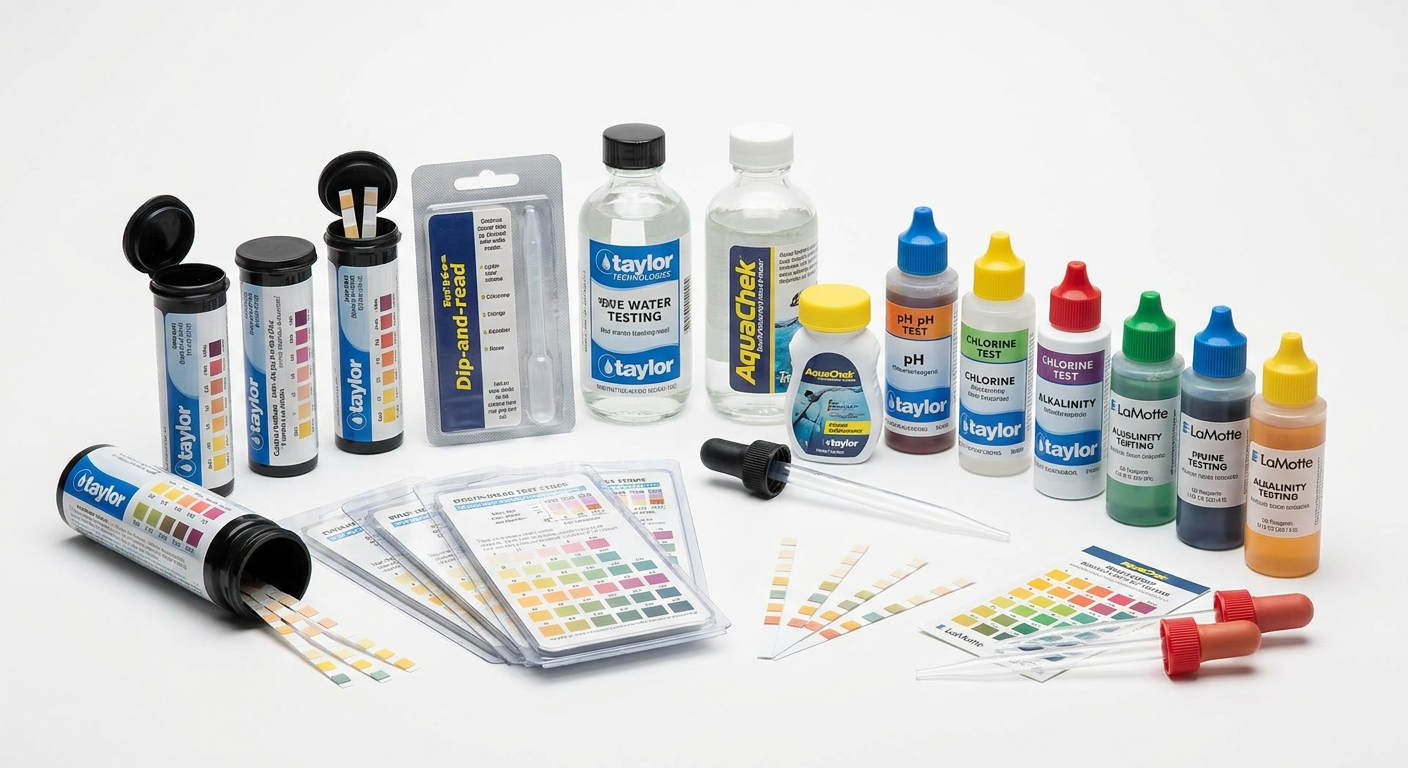
Pool owners have several options when it comes to testing water. The three main categories are test strips, liquid reagent kits, and digital testers. Each type has its own advantages and limitations.
Test strips are the most convenient option. They are simple to use and provide quick results.
The user dips a strip into the water, waits a few seconds, and compares the colour changes to a chart.
Many strips test multiple parameters at once, making them a popular choice for weekly checks. However, they may be less accurate than liquid-based tests.
Liquid reagent kits use chemical solutions that react with water samples to produce colour changes or titration endpoints.
These kits are widely regarded as more accurate than strips.
Many multi-way kits test for chlorine, bromine, pH, alkalinity, and acid demand.
The K-2005 Complete Test Kit, for example, is a top-selling option among pool professionals and homeowners who want reliable readings.
Digital testers provide precise numerical readings and remove the guesswork of colour matching. They are especially useful for measuring total dissolved solids or salt levels in saltwater pools. While convenient, digital testers require regular calibration and battery replacement.
Key Parameters to Monitor
Regular testing should cover several essential parameters. The most critical are pH, free chlorine, total alkalinity, and calcium hardness. Depending on the type of pool, bromine and cyanuric acid may also need monitoring.
Free chlorine should be maintained between 1 and 3 parts per million.
Bromine, which is often used in spas and indoor pools, should be kept between 3 and 5 ppm. Total alkalinity should stay between 80 and 120 ppm.
Calcium hardness should fall between 200 and 400 ppm for plaster pools, though vinyl and fibreglass pools can tolerate lower levels.
Testing for cyanuric acid is important for outdoor pools that use chlorine. The recommended range is 30 to 50 ppm. Levels above 100 ppm can reduce chlorine effectiveness and may require partial draining to correct.
Choosing the Right Test Kit
Selecting the right testing solution depends on several factors.
The type of pool, the frequency of use, and the level of accuracy required all play a role.
For most residential pool owners, a 5-way or 6-way liquid reagent kit provides a good balance of accuracy and coverage.
These kits test for chlorine, bromine, pH, alkalinity, and acid demand, covering the most common adjustment needs.
For those who prefer speed and simplicity, test strips are a practical choice.
Many homeowners use strips for quick weekly checks and follow up with a liquid kit when more precision is needed.
Digital testers are ideal for saltwater pools or for users who want to track specific metrics like TDS or salinity.
Whichever method you choose, the quality of the testing tools matters.
Reliable manufacturers produce reagents to strict standards, ensuring consistent results.
Pool owners looking for dependable options should explore a range of swimming pool water test kits to find one that matches their maintenance routine and budget.
Tips for Accurate Water Testing
To get the most reliable results, follow the instructions provided with your test kit. Use a clean water sample taken from elbow depth, away from return jets and skimmers. Handle reagents with care and store them in a cool, dry place away from direct sunlight.
Reagents have a limited shelf life. Replace them at the beginning of each swimming season or according to the manufacturer’s recommendations. Testing at the same time each week, preferably in the morning before the pool gets heavy use, helps establish a consistent baseline.
It is also important to calibrate digital testers regularly according to the manufacturer’s guidelines. Keep spare batteries on hand and store the device in a protective case when not in use.
Conclusion
Regular water testing is the foundation of effective pool maintenance.
By understanding the key chemical parameters and using reliable testing tools, pool owners can ensure their water remains clear, safe, and comfortable.
Whether you choose test strips for quick checks or a comprehensive liquid reagent kit for detailed analysis, consistent monitoring is the best way to protect your investment and enjoy your pool all season long.
Related Article

TodayPK 2026: Movies, Downloads & Safe Options

MLWBD Movies: Download Guide & Safety