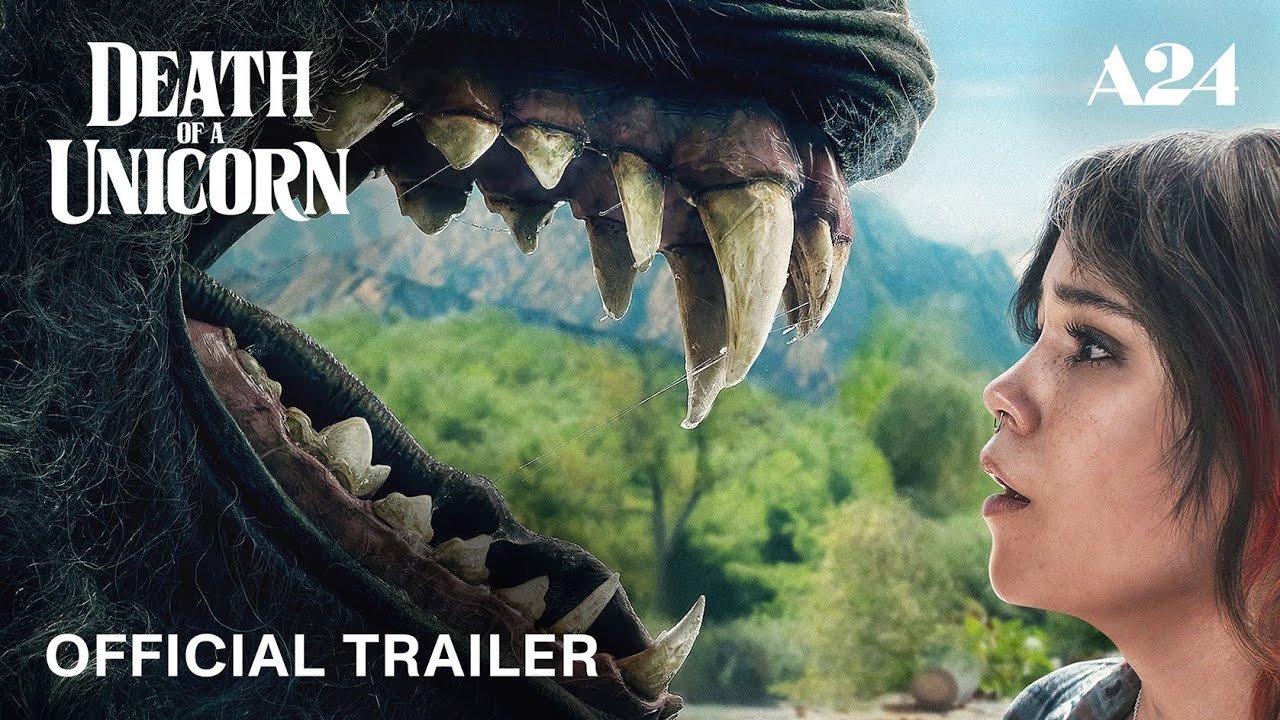
Death of a Unicorn (2025) – Complete Review – Mallumv
In the realm of cinematic storytelling, few titles are as striking and enigmatic as “Death of a Unicorn”. Released in 2025, this film quickly captured the attention of audiences and critics alike—not only due to its unique title and intriguing narrative but also because of the high-profile cast, ambitious thematic scope, and the mysterious tone that permeates its storytelling.
This article explores “Death of a Unicorn (2025)” in-depth, covering its production background, plot, themes, characters, critical reception, and cultural impact. Whether you’re a cinephile, a curious viewer, or a critic of modern cinema, this detailed review and analysis will provide a comprehensive understanding of one of the most talked-about films of the year.
Background and Production
Origin and Concept
The concept of “Death of a Unicorn” was initially shrouded in secrecy. First announced in 2023, the film was developed under the working title Project Larkspur, giving little indication of its fantastical or metaphorical elements. The screenplay, penned by debut writer-director Alex Scharfman, was quickly picked up by A24—known for backing avant-garde, atmospheric films that often blur the line between reality and fantasy.
According to interviews with the director, the story was inspired by a series of dreams and childhood stories involving unicorns as metaphors for purity, loss, and transformation. The final title, “Death of a Unicorn”, reflects a culmination of those inspirations, symbolizing the loss of innocence in a morally complex world.
Casting and Crew
One of the film’s biggest draws was the casting of Jenna Ortega and Paul Rudd as a daughter-father duo. Ortega, fresh from a series of breakout roles in genre films and streaming hits, played the teenage protagonist Riley, while Rudd, known for his charm and comedic timing, took on a more serious, introspective role as David, her father.
Supporting cast included:
- Sophie Okonedo as Dr. Marin, a conflicted biologist.
- David Oyelowo as Marcus Deyn, the CEO of a biotech conglomerate.
- Finn Wolfhard as Tyler, a mysterious traveler encountered during the journey.
Cinematography was led by Rob Hardy, known for his ethereal and surreal visual style. The score was composed by Mica Levi, whose dissonant and haunting compositions added an eerie depth to the narrative.
Filming and Locations
Principal photography took place in a combination of real and surreal locations. Forests in the Pacific Northwest, sprawling biotech facilities in upstate New York, and abandoned industrial complexes provided the physical landscape of the film. Many scenes employed practical effects, interwoven with subtle CGI to maintain a grounded realism while still allowing for dreamlike sequences.
Plot Summary
Opening: A Tragic Encounter
The film opens with a prologue—a dream sequence where a young girl wanders through a fog-shrouded forest. She comes across a wounded unicorn, ethereal and glowing. As she approaches to help, the unicorn dies in her arms. This sets the tone for a film that constantly weaves between the real and the surreal.
In the real world, Riley (Ortega) and her father David (Rudd) are on a weekend road trip, trying to reconnect after years of estrangement following the death of Riley’s mother. Their relationship is strained, and small arguments pepper the journey.
As night falls, they hit what appears to be a unicorn in the middle of the road. The creature is badly injured but alive. Riley insists they help, while David is skeptical. The decision to save or abandon the creature sets the main narrative in motion.
Middle Act: Corporate Intrigue and Moral Dilemmas
Riley and David bring the unicorn to a secluded animal rescue center. Word of the mythical creature spreads, and soon, the biotech corporation GenSynth, led by Marcus Deyn, intervenes. They claim jurisdiction over the unicorn, citing it as a genetically engineered prototype created decades ago in secret.
David, a former GenSynth employee, begins to suspect the creature is tied to experiments he was once part of but was made to forget. As he reconnects with Dr. Marin, an old colleague, disturbing truths come to light. The unicorn is not just a symbol of magic—it’s a biological anomaly created through unethical experimentation.
Riley, meanwhile, forms a deep emotional bond with the unicorn, viewing it as a symbol of her mother’s spirit and a beacon of purity in a corrupt world. Her attachment grows as she uncovers journal entries from her mother, who once worked with GenSynth and protested their experiments.
Climax: Confrontation and Consequences
As GenSynth moves to seize the unicorn by force, Riley and David go on the run with the creature, heading to a rumored sanctuary in the mountains where the unicorn might be safe. Along the way, they are pursued, not just by corporate agents but also by inner demons—grief, guilt, and trauma.
In a dramatic climax atop a misty cliff, David sacrifices himself to distract their pursuers, allowing Riley and the unicorn to reach the sanctuary. However, the unicorn, sensing danger and unwilling to be the source of more suffering, walks into a lake and disappears into the mist, vanishing without a trace.
Ending: Catharsis and Reflection
The final scenes are quiet and somber. Riley, now alone, visits her mother’s grave and leaves behind a drawing of the unicorn. Her voiceover reflects on what the unicorn meant—not as a creature of legend but as a symbol of truth, loss, and the fleeting nature of innocence.
Themes and Symbolism
The Unicorn as a Symbol
The titular unicorn in the film operates on several symbolic levels:
- Innocence and Purity: It represents the untouched part of the human soul, threatened by exploitation.
- Grief and Loss: The death of the unicorn parallels Riley’s personal journey through mourning and emotional healing.
- Scientific Hubris: The creature’s origins tie into critiques of bioethics, corporate control, and human arrogance in playing god.
Parent-Child Relationships
At its core, “Death of a Unicorn” is about the evolving relationship between a father and daughter. Through their shared ordeal, David and Riley confront their personal failures and rebuild a sense of trust and love. The emotional resolution, though tinged with loss, is deeply human and sincere.
Corporate Ethics and Genetic Engineering
The inclusion of GenSynth and the scientific background of the unicorn roots the film in contemporary concerns about biotechnology, animal rights, and corporate accountability. Rather than giving easy answers, the film presents a morally ambiguous narrative, forcing viewers to question their assumptions.
Dream vs. Reality
With its dreamlike visuals and metaphysical overtones, the film often blurs the line between what is real and imagined. Is the unicorn truly magical, or is it a product of human engineering? Is its death literal, or metaphorical? The ambiguity adds depth and invites multiple interpretations.
Visual Style and Aesthetic
Cinematography
Rob Hardy’s cinematography is one of the film’s standout elements. He uses natural light, long takes, and shallow focus to evoke intimacy and tension. Forest scenes are rich with contrast—dark trunks and vibrant greens—while lab environments are sterile and cold, reinforcing thematic dichotomies.
Color Palette
The color palette evolves with the narrative:
- Warm and nostalgic tones during flashbacks.
- Cool, desaturated hues in scenes involving GenSynth.
- Mystical iridescence surrounding the unicorn, making it a visual anomaly in a grounded world.
Sound and Music
Mica Levi’s score is minimalist yet powerful. Dissonant strings, ambient noise, and sudden silences enhance emotional weight. The use of diegetic sound—rustling leaves, distant animal calls—immerses viewers in the film’s atmospheric tension.
Character Analysis
Riley (Jenna Ortega)
Riley is the emotional heart of the film. Her journey from skepticism to belief, from anger to empathy, reflects a coming-of-age arc shaped by loss and resilience. Ortega delivers a nuanced performance that balances vulnerability with defiance.
David (Paul Rudd)
In one of his most serious roles to date, Rudd surprises with emotional depth. David is a man burdened by past mistakes, seeking redemption through his daughter. His transformation is subtle yet powerful, culminating in a selfless act of love.
Dr. Marin (Sophie Okonedo)
A conflicted character, Marin represents the moral gray area of science. Once complicit in GenSynth’s work, she now seeks to atone. Her interactions with Riley offer mentorship and a contrasting adult female presence.
Marcus Deyn (David Oyelowo)
As the film’s antagonist, Deyn is charismatic, rational, and terrifyingly logical. He believes in progress at any cost, a portrayal that feels all too real in today’s tech-driven world.
Critical Reception
Audience Response
Audiences were divided. Some praised the film’s ambition, visuals, and emotional storytelling. Others found its pacing slow or its symbolism heavy-handed. However, few disputed its uniqueness or the strength of its performances.
Critical Reviews
Critics largely lauded the film for its originality and thematic depth. Many compared it to works by Terrence Malick and Darren Aronofsky, noting its poetic visuals and existential undercurrents. The performances of Ortega and Rudd received near-universal acclaim.
Rotten Tomatoes scored it at 88%, with consensus noting its “haunting beauty and deeply felt emotion.” Metacritic gave it 74, suggesting generally favorable reviews but noting divisive elements.
Cultural Impact and Legacy
Debates and Interpretations
“Death of a Unicorn” sparked numerous debates online, particularly regarding the film’s ending. Was the unicorn real or a projection of grief? Was David’s sacrifice necessary or symbolic? Fan theories proliferated, drawing connections to myth, science fiction, and Jungian psychology.
Awards and Recognition
The film garnered several nominations during awards season:
- Best Original Screenplay (Academy Award)
- Best Actress in a Leading Role (Ortega)
- Best Cinematography
- Best Original Score
Though it won only a few, its nominations signified industry recognition of its artistic ambition.
Influence on Genre Films
“Death of a Unicorn” has already been cited as a landmark film in the emerging subgenre of eco-science fantasy—films that blend ecological concerns with fantastical storytelling. Its success has encouraged studios to pursue similarly themed narratives with deeper emotional cores.
Conclusion
“Death of a Unicorn (2025)” is a cinematic experience that defies simple categorization. It’s a family drama, a sci-fi parable, a fantasy fable, and a meditation on grief—all wrapped in a visually stunning package. Its bold storytelling, compelling performances, and thematic richness ensure that it will be analyzed, debated, and remembered for years to come.
In an era dominated by franchises and formulaic plots, “Death of a Unicorn” stands as a testament to the power of original storytelling, daring to explore the fragile intersections between myth and science, memory and truth, loss and love. Whether you find it a masterpiece or a mystery, its emotional resonance is undeniable.
Related Article

Sonic the Hedgehog 3 (2024) – Complete Review – Mallumv

Moana 2 (2024) – Complete Review – Mallumv